

In a significant expansion of its spatial computing strategy, Google has officially unveiled major updates to the Android XR platform. By extending native support to Unreal Engine and Godot, and introducing sophisticated new development tools like the Android XR Engine Hub and the Android XR Interaction Framework (AXRIF), Google is positioning itself as a dominant force in the cross-platform XR landscape. This move marks a departure from restrictive, ecosystem-specific development, embracing an open, industry-standard approach that aims to streamline the workflow for developers of all scales.
Main Facts: The New Frontier for Spatial Developers
The announcement, spearheaded by Android Developer Relations Engineer Luke Hopkins and Android XR Product Manager Ryan Bartley, signals a massive shift in how developers interact with Android’s spatial hardware. The core of this update rests on three pillars: engine expansion, real-time development workflows, and standardized interaction models.
For developers, the headline is the official integration of Unreal Engine and Godot into the Android XR ecosystem. Previously, Unity held a primary status in the platform’s development roadmap. By adding Unreal Engine (targeting version 5.6.1) and Godot (version 4.6.2 and higher), Google is effectively removing the barrier to entry for studios specialized in high-fidelity console-grade graphics (Unreal) or lightweight, modular, and open-source projects (Godot).
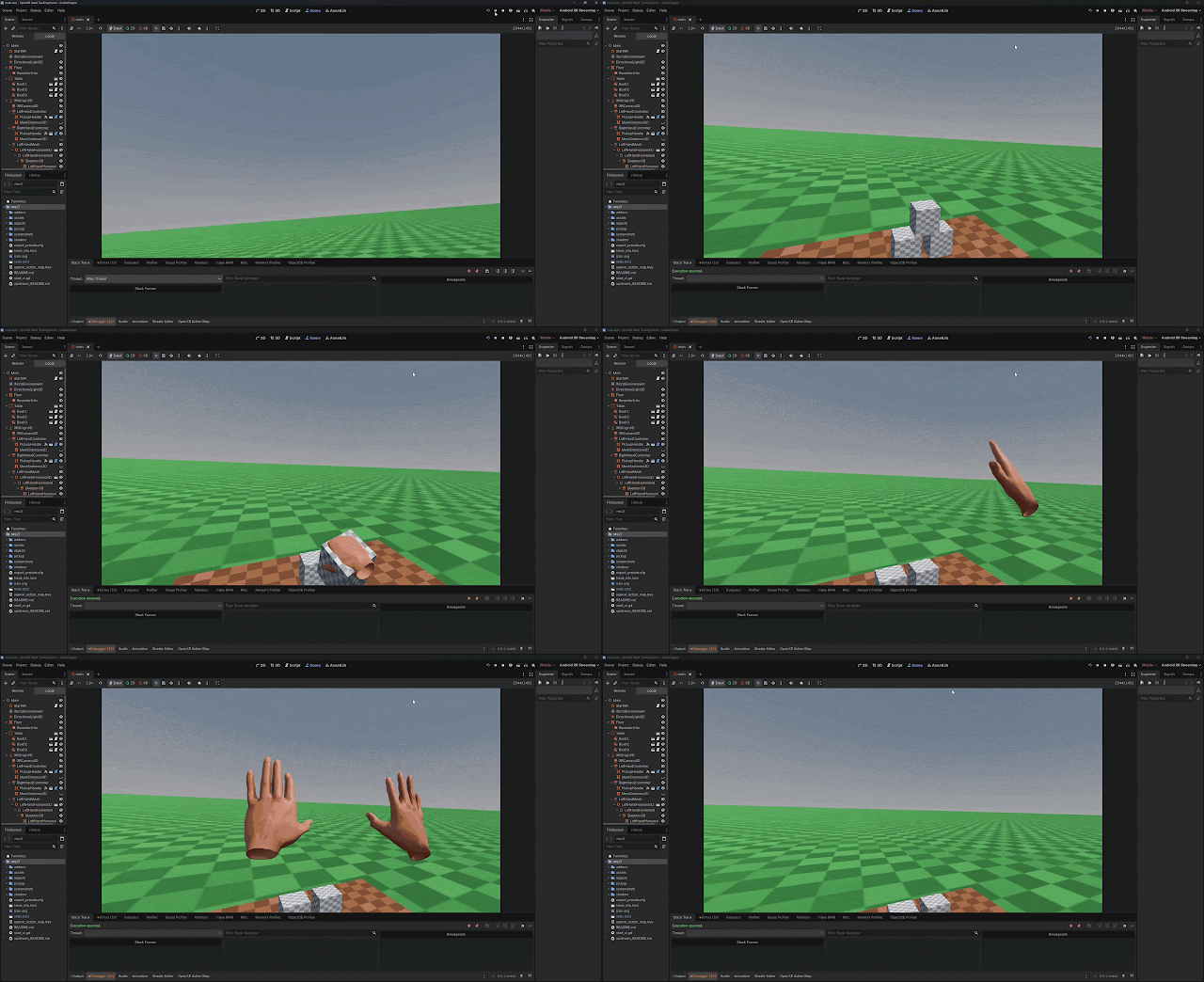
Complementing these engine additions is the Android XR Engine Hub. Designed as a "mission control" for developers, this Windows-based utility acts as a high-speed bridge between the physical headset and the development environment. By streaming sensor data—including eye-tracking, spatial mapping, and hand-tracking telemetry—directly into the engine’s "Play Mode," Google is effectively eliminating the "build-deploy-test" cycle that has historically plagued XR development.
.png)
Chronology: Building Toward a Unified XR Vision
The journey toward this release reflects Google’s broader commitment to OpenXR, the royalty-free open standard for accessing XR platforms.
- Initial Android XR Foundations: Google focused on establishing a robust, performance-oriented foundation for spatial computing, centered primarily on the Unity engine and the OpenXR standard.
- The Pivot to Multi-Engine Support: Recognizing that the developer community is fragmented across different creative pipelines, Google began working with the Godot Foundation and W4 Games to ensure the open-source community could leverage the same low-latency sensor data as large-scale commercial studios.
- Beta and Developer Preview Phase: Throughout early 2026, Google stress-tested the Engine Hub’s low-latency streaming capabilities, ensuring that the "Direct Preview" feature could handle the high-bandwidth requirements of 6DoF (six degrees of freedom) tracking without sacrificing accuracy.
- Google I/O 2026 Announcement: The current suite of tools was unveiled, marking the transition from experimental support to production-ready integration. This launch aligns with the release of Unity 6.5 Beta, indicating that Google is keeping pace with major engine updates simultaneously.
Supporting Data: Enhancing Workflow and Performance
The technical implications of the Android XR Engine Hub are profound. In traditional development, a developer wanting to test a change in a spatial interaction—such as how a virtual object reacts to a user’s gaze—would be required to compile an APK, push it to the device, and wait for the application to launch. This cycle, which can take minutes per iteration, is reduced to milliseconds via the Engine Hub’s streaming protocol.
By virtualizing the device’s hardware capabilities, the Hub allows developers to keep their "hands" in the engine. Whether utilizing Unreal Blueprints or Godot’s GDScript, the engine now receives live input from the headset’s sensors as if the code were running natively on the device.
Furthermore, the Android XR Interaction Framework (AXRIF) acts as a force multiplier. By providing an unstyled, modular toolkit, it abstracts the complex math required for system-level interactions. For instance, the "Transition Manager" within AXRIF automatically handles the state switching between 3D mouse inputs, hand gestures, and eye-gaze tracking. This ensures that an application doesn’t just "work" on the headset, but "feels" native to the operating system, matching the user experience of system-level apps.

Official Responses and Strategic Partnerships
The collaboration with external partners highlights a shift in Google’s strategy toward "co-opetition" and open standards.
W4 Games, the organization behind the commercial support for the Godot engine, has been instrumental in this rollout. According to representatives, the successful porting of experiences like MoAT and Expedition to Blobotopia to the Google Play Store serves as a proof-of-concept that Godot is not merely a hobbyist tool, but a production-grade engine capable of delivering high-performance spatial experiences.
"By collaborating with Google to optimize our OpenXR implementation," a spokesperson for the Godot Foundation noted, "we are ensuring that the Android XR power profile is respected, allowing developers to focus on creativity rather than hardware-level performance tuning."
Meanwhile, the Unity integration has reached a new level of maturity. With the release of Unity 6.5 Beta and the 1.13 OpenXR package, developers now have access to improved "Application SpaceWarp," a technique that uses motion vectors to synthesize frames, effectively doubling the perceived frame rate. The expansion of this feature to support uGUI and TextMeshPro signals that Google is listening to the UI/UX needs of developers who require high-density text and complex interface elements in 3D space.

Implications: A More Competitive XR Landscape
The implications of this announcement are widespread for the future of spatial computing:
- Lowering the Barrier for Indie Developers: By providing free, robust tools for engines like Godot, Google is fostering an ecosystem where small teams can produce high-quality XR content that competes with large, venture-backed studios.
- Standardization as a Competitive Moat: By leaning heavily into OpenXR and providing a unified bridge through the Engine Hub, Google is making it easier for developers to port their existing content to Android XR. This effectively creates a "gravity well" that pulls existing XR content into the Android ecosystem.
- The "Native Feel" Expectation: The introduction of AXRIF raises the bar for user experience. As more developers adopt this framework, users will begin to expect a high level of consistency in how they interact with applications. Apps that do not follow these standardized patterns—such as the transition between hand-tracking and controller input—will likely be viewed as "low quality" by the market.
- Hardware Independence: While these tools are currently centered on Android XR, the reliance on OpenXR means that the code written today is significantly more portable. Developers are no longer locking their intellectual property into a proprietary SDK, which mitigates risk for studios investing in long-term XR product development.
Looking Forward: The Path to Widespread Adoption
As the developer community begins to integrate these tools, the focus will likely shift toward performance optimization and the creation of more complex, multi-modal experiences. The removal of the "Hand Mesh" extension in favor of a unified data package suggests that Google is in the process of "pruning" its API to be more efficient and developer-friendly.
For those looking to begin their journey, the documentation for the Android XR Engine Hub and the AXRIF toolkit is currently live. As Google continues to iterate on these tools through the remainder of 2026, the focus will undoubtedly be on scaling these capabilities to handle even more complex spatial data, such as real-time light estimation and advanced environmental occlusion.
The era of proprietary, closed-loop XR development is rapidly drawing to a close. With this latest update, Google has provided the tools to ensure that the next generation of spatial applications is not just built, but built with the efficiency, consistency, and standard-compliant architecture required to define the future of the medium. Whether you are a solo developer using Godot or a large-scale studio leveraging the power of Unreal Engine 5, the Android XR ecosystem is now open for business, offering a sophisticated, streamlined, and increasingly powerful foundation for the next wave of computing.
